Ethylene gas is produced by fruit and vegetables and accelerates the growth, development, ripening and ageing of the product. Some fruit varieties, for example kiwis, are extremely sensitive to ethylene. Whilst others like apples are less sensitive.
The effect of ethylene differs from product to product. For some products it enhances the rate of respiration, whilst for other produce it initiates or accelerates ripening.
Removal of ethylene can help maintain product quality and extend the shelf life of produce.
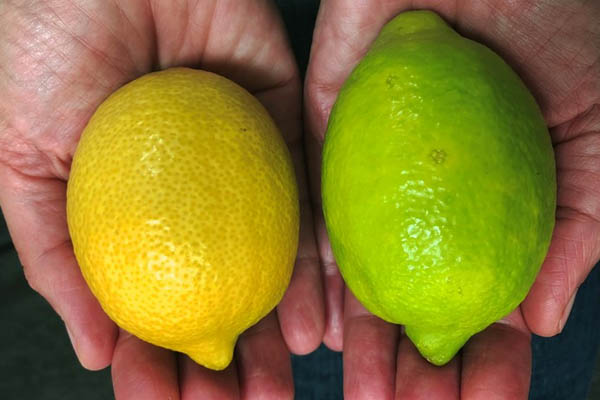
Degreening is a post-harvest process of removing the green colouring from the skin of citrus fruit. The green color in citrus fruit is primarily due to the presence of chlorophyll, the same pigment that gives plants their green color.
The degreening process involves exposing the harvested citrus fruits to controlled conditions of temperature and humidity, supplemented with ethylene gas. The ethylene gas activates a specific enzyme in the citrus fruit’s peel, which breaks down chlorophyll.
Degreening is important because consumers generally prefer orange, yellow, or other ripe colors of citrus fruit over the green color of unripe fruits. It also helps improve the marketability of citrus fruits, making them more visually appealing to consumers. However it is essential to control the degreening process carafully to avoid quality degradation of the fruits.
Degradation can be initiated by deviating values of Temperature, Relative Humidity, CO2, O2 and ethylene.
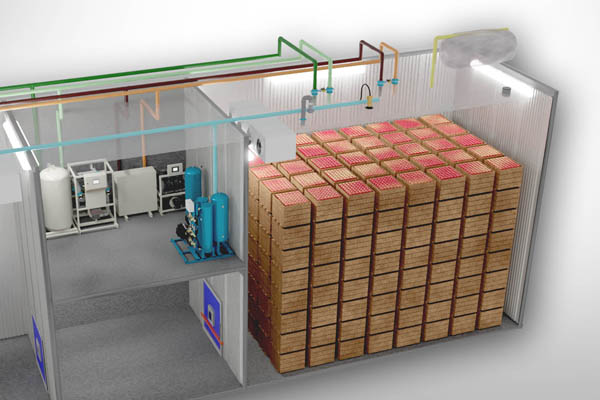
The Besseling Atmospheric Control station can perfectly monitor and control your degreening process. By controlling temperature, relative humidity, oxygen, CO2 and ethylene levels, according to a pre-set protocol.
Ethylene is also called the ripening hormone. It plays a crucial role in the ripening of many fruit species. Most fruits produce ethylene to start the ripening process. This is favorable when it leads to ripe and tasty products.
To force produce into ripening, ethylene gas is introduced into so-called ripening rooms.
We can advise two types of ripening:
By introducing ethylene gas into a ripening chamber, the ripening of fruits can be initiated. To reach optimal results, it is key to do this in a controlled way. Once the ripening is initiated, the fruit will start itself to produce more ethylene which accelerates the ripening even more. Therefore Ethylene levels up to 100-150ppm is more than sufficient to start up the ripening process. But also air circulation, temperature, humidity and CO2 levels play an important role in the ripening process.
In traditional ripening, each product has its own protocol which is used to ripen the product in question.
If done in a controlled way, it is possible to create fully homogeneously ripened fruit.
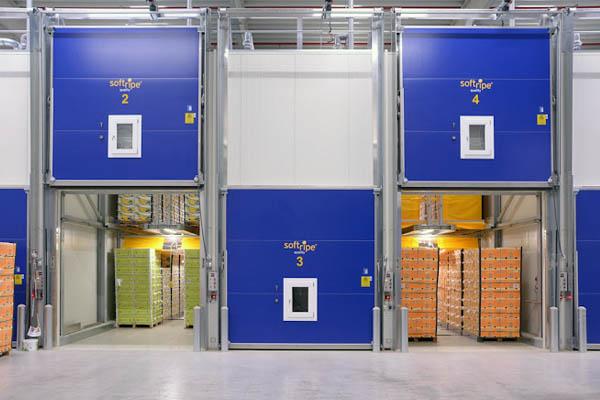
Softripe is a Brazilian-German innovation and stands for a novel ripening technology for tropical fruits. This allows a significant improvement in the respective fruit quality compared to conventional methods.
In the case of conventional ripening, fixed time and parameter programs are applied without going into the physiological requirements of each fruit. The fruit is ripened under stress.
With Softripe an intelligent and complex software controls the ripening process in order to ripen the fruit in a way that is completely controlled and stress-free. All natural gases found in air and respiratory gases (e.g. oxygen, nitrogen, carbon dioxide) and ethylene, the fruit gas, are permanently controlled and optimally adjusted for the fruit to be ripened.
This natural way of ripening results in Better shelf life, better aroma and better digestibility.